
Between appointments is where recovery is lost.
Subreal-CARE is an investigational class IIb software as a medical device for opioid, alcohol and benzodiazepine use disorders. It turns daily signal into near-term risk, and near-term risk into a clinician's decision while the patient is still engaged.
A daily thirty-second video check-in, short validated scales and passive phenotyping that runs quietly in the background. Designed to feel like care, not surveillance — with the patient able to see their own trend.
One caseload view ordered by near-term risk, with the context behind each change: which signals moved, when, and how far from that patient's own baseline.
When risk crosses a threshold agreed in advance with the service, the treating team is alerted. No automated contact with the patient, no automated change to treatment.
Built around the patient’s day, not around a dashboard.
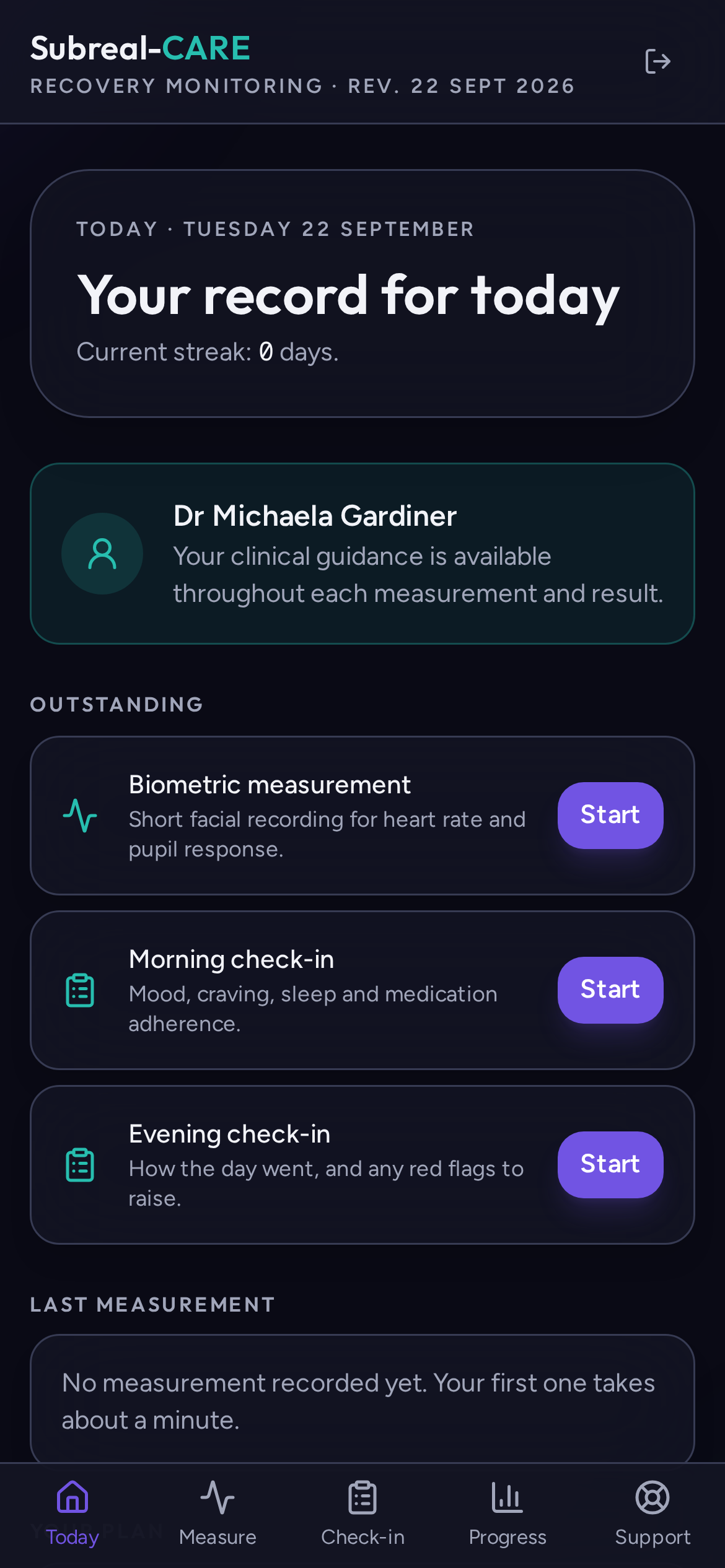
Measurements and check-ins are presented as a short, manageable daily record.
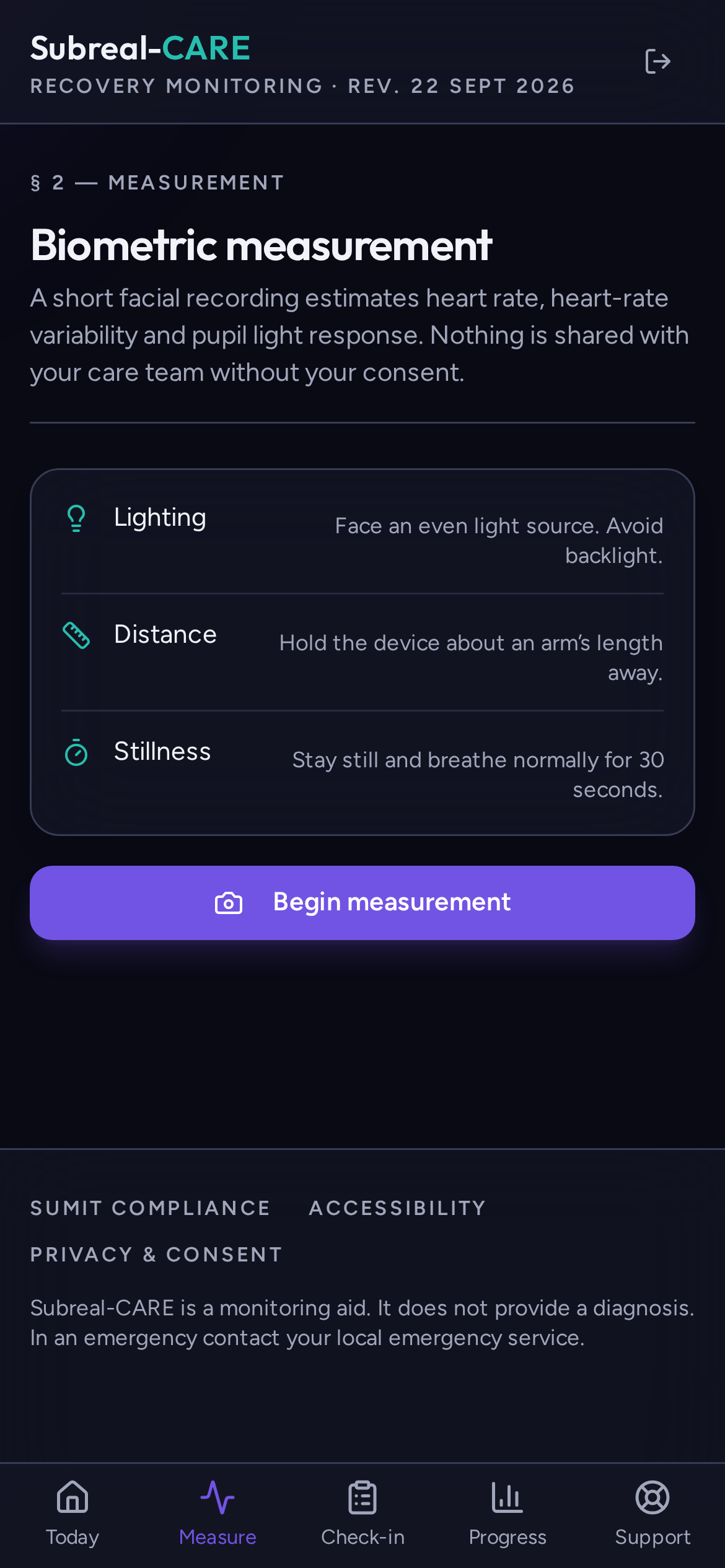
Simple preparation makes the smartphone camera measurement understandable and repeatable.
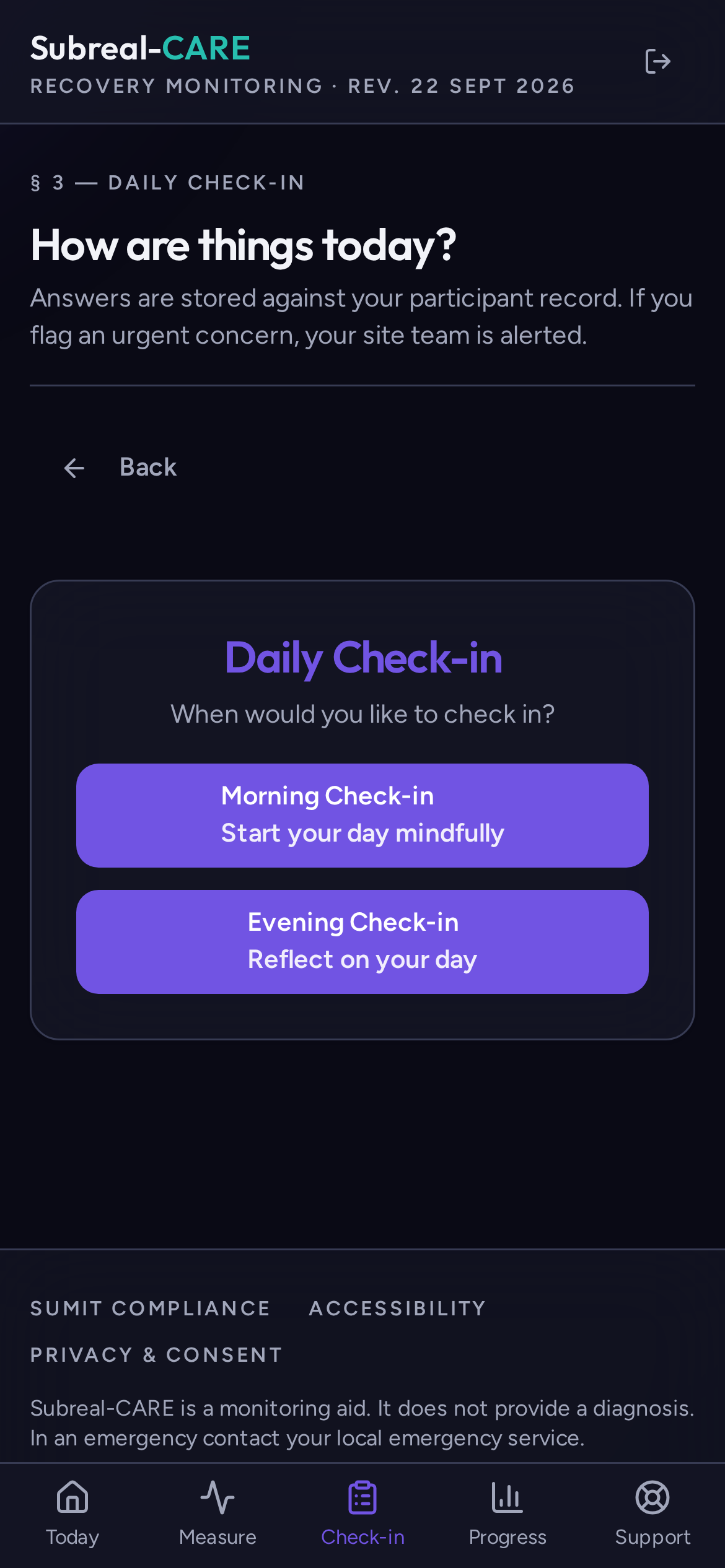
Mood, craving, sleep and medication adherence, asked briefly and at a consistent time of day.
A five-step loop, repeated until the risk drops.
Built to medical-device standards. The same loop feeds Subreal-CARE today and the longitudinal record that Subreal-General will learn from tomorrow.
- M1CaptureShort video check-ins, validated psychometrics and passive app-use phenotyping — collected daily inside the patient app, designed to feel like care, not measurement.
- M2ExtractVideo is converted into digital biomarkers spanning neurological, physiological and psychometric signal — a multimodal feature set unique to each patient.
- M3PredictOur model fuses these biomarkers with the patient's longitudinal history to estimate near-term risk of relapse and overdose.
- M4EscalateWhen risk crosses a pre-specified safety threshold, the treating team is alerted with the context that matters.
- M5InterveneThe clinician decides — contingency management, motivational interviewing, or pharmacological action. We surface, they treat.
The pattern is there weeks before anyone reports it.
Switch the signals on and off to see how the risk picture changes over a three-week window. This is a worked illustration of the method, not live model output or a real patient record.
The treating team is alerted on day 12, while the patient is still engaged.
That is 8 days earlier than self-report alone, which only crosses the threshold on day 20.
Illustrative figures for explanation only. Subreal-CARE is investigational; escalation thresholds are pre-specified with the treating service, and every alert is reviewed by a clinician before any change to care.
- Is this a diagnostic tool?
No. Subreal-CARE is an investigational class IIb SaMD that supports monitoring and triage. It does not diagnose and does not replace clinical judgement.
- What happens to the video?
Video is reduced to numerical features for prediction. Retention is minimised and agreed with the service under UK GDPR, with a lawful basis and DPIA in place before any deployment.
- What does a service have to do?
Identify a cohort, agree escalation thresholds and a route for alerts. We provide setup and clinician training.
- Can patients opt out?
Yes, at any point, without affecting their treatment.